40% Yield Increase in Sunflower Microgreens With No Additional Input
Objective
To evaluate whether replacing standard filtered water with nanobOx nanobubble-enriched water could improve growth behaviour and harvest yield in sunflower microgreens under otherwise identical cultivation conditions.
Methodology
Two treatment groups were grown side-by-side under consistent environmental parameters:
- Control: Standard filtered water
- nanobOx: Nanobubble-enriched water used for soaking, irrigation, and misting
Environmental controls (light levels, photoperiod, nutrient inputs, airflow, humidity) were kept constant. Growth was monitored across a 10-day cycle, from sowing to harvest.
Key Findings
1. Significant Biomass Increase (+40%)
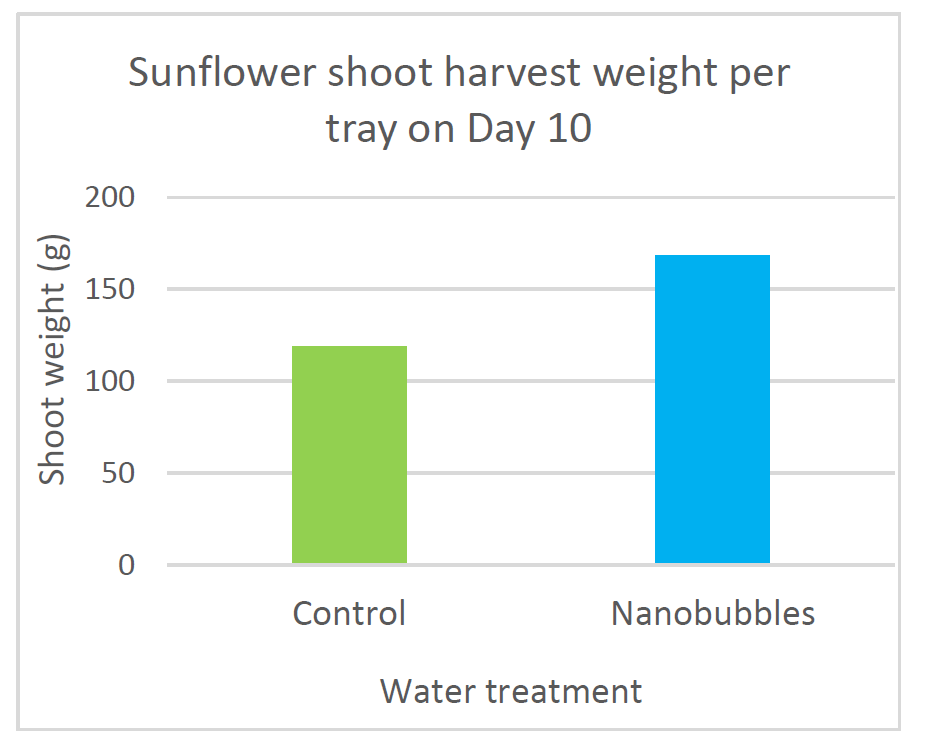
nanobOx-treated trays delivered roughly 40% higher fresh weight at harvest. This magnitude of increase is substantial given the short crop cycle and high-density production typical of microgreens.
2. Improved Canopy Structure & Stem Physiology
Nanobubble-treated plants showed:
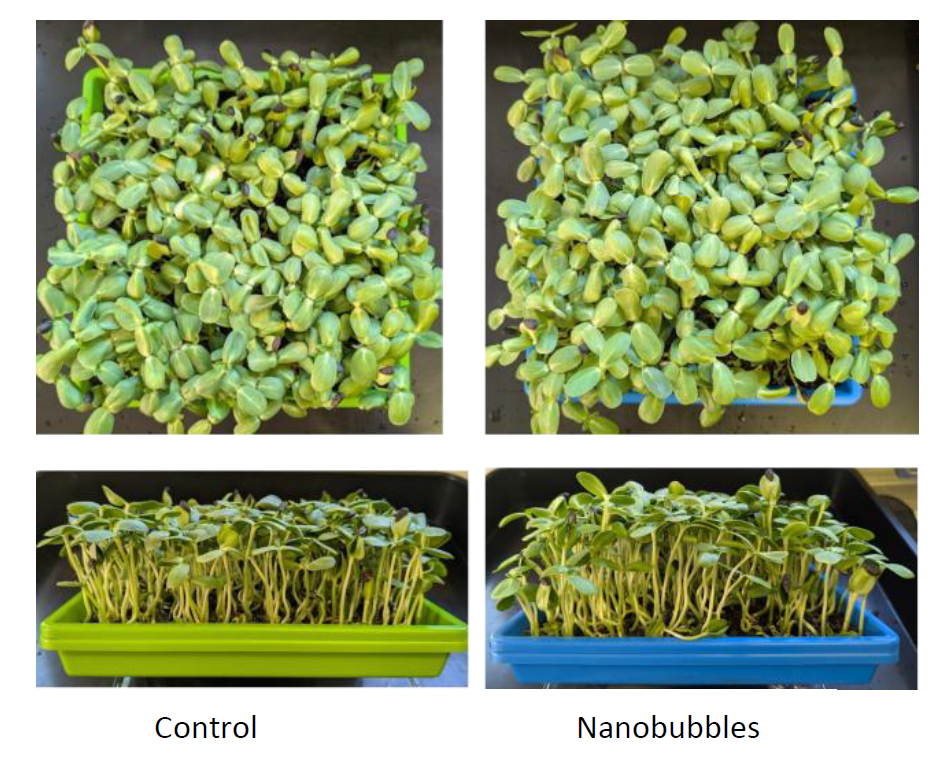
- Denser and more uniform canopy coverage
- Noticeably thicker stems
- Improved turgor and structural robustness
Shoot height distribution remained similar to the control, suggesting that nanobubbles influenced overall mass accumulation more than vertical elongation.
3. Enhanced Crop Vigour
Treated trays exhibited vibrant colouration and no visual signs of abiotic stress. This indicates that nanobubbles may enhance water uptake, oxygen availability, or nutrient mobility within the substrate environment.
Technical Interpretation
Microgreens respond strongly to oxygen availability and water–substrate dynamics due to their rapid growth and shallow rooting. The results suggest that nanobubbles:
- Increase dissolved oxygen stability in irrigation water
- Improve root-zone oxygenation
- Potentially influence nutrient solubility and diffusion
- Enhance early root establishment, driving higher shoot mass
Because no fertilisers or environmental conditions were altered, the observed gains can be attributed to the water treatment variable alone.
Implications for Growers
This study demonstrates that nanobubble technology can:
- Boost yield and product quality without additional inputs
- Improve cycle efficiency in high-turnover crops
- Integrate easily with existing irrigation systems
- Deliver benefits that scale proportionally with tray volume and frequency
For commercial microgreens production — where margins are tight and throughput is critical — the ability to achieve a 40% yield uplift through water treatment alone is highly impactful.
Next Steps
Nanobubble Insights is expanding trials to:
- Validate consistency across multiple cycles and environmental conditions
- Quantify underlying physiological mechanisms
- Extend testing to new species (basil, kale, and additional microgreens)
- Support partner trials in working vertical-farm and greenhouse operations
Results to date across sunflower, radish, and pea microgreens show promising cross-crop consistency.
